
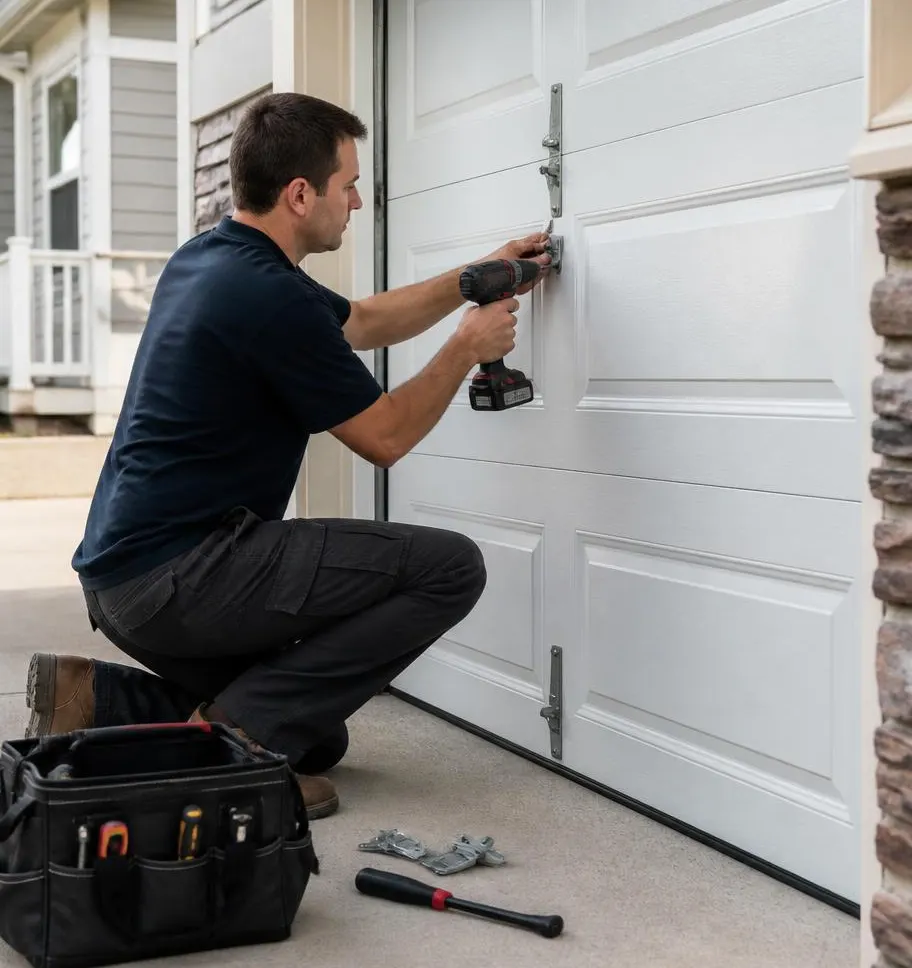
What a Service Call Usually Looks Like
The calls follow a pattern this time of year. A homeowner hits the remote, the door starts down, gets about a foot or two from the ground, then reverses back up on its own. Or the door won't move at all—the opener motor runs, lights blink, but nothing happens. Sometimes it's intermittent: works fine in the morning, acts up after an afternoon downpour. None of these are random. Each points to a specific part of the system, and a technician checks them in a predictable order because that's the order from easiest fix to most involved.
First Check: The Safety Sensors
Every opener made in the last few decades has two small sensors mounted a few inches off the ground on either side of the track, with a thin beam running between them. If anything breaks that beam while the door is closing, the opener reverses the door immediately as a safety measure. This is the single most common cause of a door that starts closing and reverses, and it's the first thing worth ruling out before assuming something is mechanically wrong.
- Misalignment: A bump from a bike, a parked car, or just years of vibration can knock one sensor slightly out of alignment with the other. Most sensors have a small LED that goes solid when they're aligned and flickers or goes dark when they're not.
- Obstruction: A stray box, a pet, a shadow from low afternoon sun, or even a spider web stretched across the beam will trigger a reversal.
- Moisture and grime: Humidity and the occasional afternoon storm leave condensation or a film of dust on the sensor lenses. Wiping both lenses with a dry cloth and rechecking alignment solves more of these calls than people expect.
The fix here is usually free and takes a few minutes—realign the brackets, clear the obstruction, or clean the lenses. If a sensor is cracked or its wiring has been chewed or corroded, it needs to be replaced, which is a low-cost part and a quick swap.
Second Check: The Track
If the sensors check out, the next stop is the track itself. A door that catches on something in the track will often stutter, reverse, or stop partway because the opener senses resistance and treats it like an obstruction.
- Debris and buildup: Grit, pollen, and pine debris collect in the track and are more noticeable after wind events.
- Rust and pitting: Humidity and, for homes closer to the coast, salt air can corrode track surfaces over time, creating rough spots that catch the rollers.
- Bent or shifted sections: A hard knock from a vehicle, a storm-driven branch, or a door that's been forced closed by hand can bend the track just enough to cause binding.
Cleaning and lubricating the track is a maintenance-level fix. A bent track usually needs to be straightened or, if the damage is significant, replaced in that section—this is where a tune-up visit earns its keep, since a technician can spot early rust or minor bends before they turn into a stuck door.
Third Check: Rollers and Hinges
Swollen wood door panels, rollers that have gone out of round, or hinges that have loosened all add resistance to the door's travel. In a humid climate, rollers made of certain materials swell or stiffen just enough to change how smoothly the door moves through the track, and the opener reads that extra resistance as a reason to stop or reverse. A technician will manually move the door (with the opener disconnected) to feel for rough spots, then replace worn rollers or re-seat loose hinges as needed.
Fourth Check: Spring Tension
If the door feels heavy when lifted by hand, or if it's noticeably harder to open than it used to be, worn springs are likely in play. Springs lose tension gradually, and most homeowners don't notice until the opener starts struggling to lift the door's full weight. When that happens, the opener's motor works harder than it should, the door moves unevenly, and it can stop or reverse mid-cycle. This is not a DIY repair—torsion springs are under heavy tension and require the right tools and experience to replace safely.
Fifth Check: Cables
A cable that's slipped off its drum or started to fray will throw the door off balance as it travels, causing one side to drop faster than the other. The opener senses that imbalance as resistance and reverses the door to protect it. Frayed cables are a safety issue on their own and should be replaced before they fail completely, not patched or tensioned temporarily.
Last Check: Opener Settings
If everything mechanical checks out—sensors, track, rollers, springs, and cables—the remaining possibility is that the opener's close-force or travel-limit settings have drifted out of adjustment, which can happen on its own over time or after a power surge. This is a quick adjustment once a technician has confirmed nothing physical is causing the resistance.
When to Call San Mateo Door & Opener
If you've cleaned the sensor lenses and checked alignment and the door still won't close reliably, it's time to call. We'll run through track, roller, spring, and cable inspection as part of our Garage Door Tune-Up & Maintenance service, or move straight to Garage Door Cable Replacement or spring repair if that's clearly the issue. Either way, we diagnose before we replace anything, so you're not paying for parts you don't need.
If your garage door in San Mateo, Palatka, Hastings, or anywhere nearby is reversing, stalling, or refusing to close, give San Mateo Door & Opener a call today and we'll get it moving the right way again.